

3.01 Purpose
The purpose of this Article is to establish a classification system for land uses and a consistent set of terms defining uses permitted or conditionally permitted within various zoning districts.
3.02 Determinations
- A.
Classification of Uses
In the event of any question as to the appropriate use types of any existing or proposed use or activity, the Zoning Coordinator shall have the authority to determine the appropriate use type. A determination of the Zoning Coordinator may be appealed to the Board of Adjustment. In making such determinations, the Coordinator and Board of Adjustment shall consider such characteristics or specific requirements of the use in common with those included as examples of use types. Those examples, when included in use type descriptions, are intended to be illustrative, as opposed to exclusive lists.
3.03 Agricultural Use Types
Agricultural use types include the planting, cultivating, harvesting, and storage of grains, hay, or other plants; or the raising and feeding of livestock or poultry.
- A.
Horticulture
The growing of fruits, vegetables, flowers, or ornamental plants. The difference from agriculture is that horticulture deals with small scale gardening, while agriculture is done on large scale with extensive crop cultivation.
- B.
Crop Production
The raising and harvesting of tree crops, row crops or field crops on an agricultural or commercial basis. This definition may include accessory retail sales under the conditions of a Special Use Permit.
- C.
Local Food Production/Urban Agriculture
- 1.
Private Garden: On site, single owner, on owned or leased property; garden may be an accessory use to a primary permitted structure, or the primary use on a vacant lot; all produce is for private consumption only, not for retail sale. Composting of materials produced on site is allowed and that compost can be used on site.
- 2.
Community Garden: On site, single owner, multiple users, on owned or leased property; garden may be an accessory use to a primary permitted structure, or the primary use on a vacant lot; all produce is for private consumption or permitted temporary retail sale; soil test for contamination is recommended.
- 3.
Market Garden: An establishment where food or ornamental crops are grown on the ground, on a rooftop or inside a building; all produce is for permitted retail sale; mechanical equipment is limited to typical size and type used in residential settings, with the exception of seasonal bed preparation; soil test for contamination is recommended.
- 4.
Urban Farm: An establishment where food and/or ornamental crops are grown and/or processed to be sold and/or donated that includes, but is not limited to, outdoor growing operations, indoor growing operations, vertical farms, aquaponics, aquaculture, hydroponics and rooftop farms; soil test for contamination is recommended; temporary and permanent urban agriculture structures permitted (with appropriate permits).
- 5.
Onsite Farm stand: Permitted subject to approval as an accessory to a community garden, market garden or urban farm; may require a special or temporary use permit. One stand permitted per site; stand must be temporary and removable, not to exceed (duration TBD); signage must meet sign regulations. Other regulations may apply.
- 6.
Temporary Urban Agriculture Structures: Includes raised beds, cold frames, hoop houses, and high tunnels. These structures may be taken down seasonally and have no active (mechanical) venting.
- 7.
Permanent Urban Agriculture Structures: Includes greenhouses and typically have ventilation and heating systems.
- 8.
Composting: Accessory use to a local food production use type; may contain approved yard waste, household organic waste, and agricultural waste generated, composted together and used on the same site where it originated.
Must meet aeration and particle size requirements, and be contained in bins or holding areas. Size is greater than “household composting” but below the amount established by the Nebraska Department of Energy and Environment (NDEE) for (compost) operations needing a permit from the NDEE.
- 9.
Household composting: Composting by an individual household on the property that uses only materials from that property. Compost produced on site shall not be sold.
- 10.
Landscaping Business: The decorative improvements of land in any manner, including, but not limited to, contouring, and the installation of plant materials. Also includes lawn care and grounds maintenance. Includes storage of landscape materials, rocks, mulch and similar materials to be used in landscapes.
This use does not include retails sales on the premises.
- 1.
- D.
Animal Production
The raising of animals or production of animal products, such as eggs or dairy products on an agricultural or commercial basis on a site which is also used for crop production or where grazing of natural vegetation is the major feed source; or the raising of animals for recreational or educational use. Typical uses include grazing, ranching, free range dairy farming, and poultry farming.
- E.
Livestock Sales
The use of a site for the temporary confinement and exchange or sale of livestock. Typical uses include sales barns.
- F.
Commercial Feedlots
A lot, yard, building, corral, or other area in which livestock are confined, primarily for the purposes of feeding and growth prior to slaughter. The term does not include areas which are used for raising crops or other vegetation or upon which livestock are allowed to graze. Commercial feedlots are prohibited in the County.
3.04 Residential Use Types
Residential use types include uses providing wholly or primarily non-transient living accommodations. They exclude institutional living arrangements providing 24-hour skilled nursing or medical care, forced residence, or therapeutic settings.
- A.
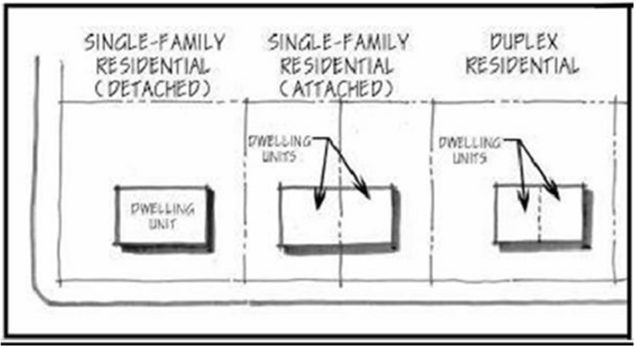
Single-Family Residential
The use of a site for one dwelling unit, occupied by one family.
- 1.
Single-Family Residential (Detached): A single-family residential use in which one dwelling unit is located on a single lot, with no physical or structural connection to any other dwelling unit.
- 2.
Single-Family Residential (Attached): A single-family residential use in which one dwelling unit is located on a single lot and is attached by a common vertical wall to only one other adjacent dwelling unit on another single lot.
- 1.
- B.
Condominium
Real estate, portions of which are designated for separate ownership and the remainder of which is designated for common ownership solely by the owners of those portions.
- C.
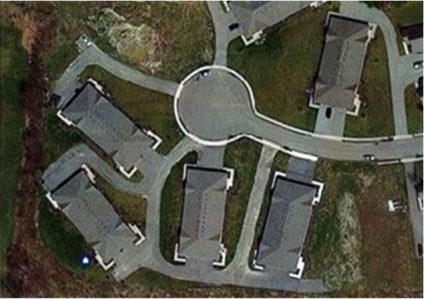
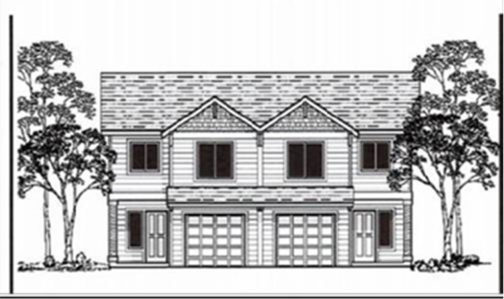
Duplex Residential
A structure containing two dwelling units, each of which has direct access to the outside.
- D.
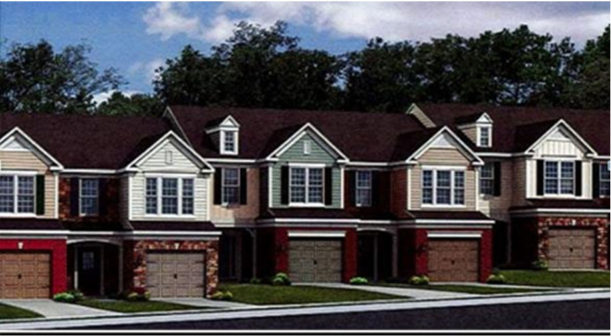
Townhouse Residential
A one-family dwelling unit, with a private entrance, which is part of a structure whose dwelling units are attached horizontally in a linear arrangement, and having a totally exposed front and rear wall to be used for access, light, and ventilation.
- E.
Multiple-Family Residential
The use of a site for three or more dwelling units within one building not otherwise defined as townhouse units.
- F.
Group Residential
The use of a site for the residence of more than three unrelated persons, not otherwise defined as a family, in which occupants are accommodated in rooms not defined as dwelling units. Group Residential uses are limited to facilities that are officially recognized or operated by a college or university, government agency, or nonprofit organization.
Typical uses include fraternity or sorority houses and dormitories not incorporated into a college and university use type.
- G.
Mobile Home Park
Use of a site under single ownership for two or more mobile home units. Generally, the land on which mobile homes are placed in a Mobile Home Park is leased from the owner of the property.
- H.
Mobile Home Subdivision
Division of a tract of land into lots that meet all the requirements of the subdivision regulations for the location of mobile homes. Generally, a lot within a Mobile Home Subdivision is owned by the owner of the mobile home placed upon such lot.
- I.
Retirement Home
A building or group of buildings which provide residential facilities, where retired people live. A retirement home may provide a range of residential building types and may also provide support services to residents, including but not limited to food service, general health supervision, medication services, housekeeping services, personal services, recreation facilities, and transportation services. The retirement residence may accommodate food preparation in independent units or meal service in one or more common areas. Retirement residences may include additional health care supervision or nursing care.
- J.
Hospice Residence
A building or group of buildings which provide hospice care services to terminally ill patients. A hospice residence may provide a range of residential building types and may also provide support services to residents, including but not limited to food service, general health supervision, medication services, housekeeping services, personal services, recreation facilities, and transportation services. The hospice residence may accommodate food preparation in independent units or meal service in one or more common areas. Hospice residences may include additional health care supervision or nursing care.
- K.
Home Occupation I (MAJOR)
These type home occupations require a special use permit and include any business or use with a part time or full time employee not residing on the premises and/or any business which involves customer visits to the location. Examples may include art/craft making, seamstress services, professional offices (real estate/insurance/medical), multi- level marketing, vending services, service businesses (contracting/janitorial/mechanical), instruction (music), consulting, wholesale/catalogue sales, personal service (beauty/barber/massage/tattoo), or other similar uses with on-site sales and services or employees traveling to and from the premises. Uses not allowed include welding, vehicle body repair, or dismantling and rebuilding of vehicles.
- L.
Home Occupation II (MINOR)
These type home occupations do not require a special use permit and include any business or use in which an office in the home, including such things as a home phone, computer, etc. are used for telecommuting and/or in deriving other income or sales. Such occupations shall have no customers or part-time or fulltime non-resident employees coming to or from the residence as part of the business operation. This includes business offices for services such as construction, repair and cosmetic services/sales rendered at other locations, internet businesses, and other similar uses.
- M.
Accessory Dwelling Unit
An accessory dwelling unit (ADU) is a second dwelling unit located on the same lot as a principal dwelling unit (PDU) that allows for additional housing options while respecting the style and scale of the surrounding area. ADUs accommodate the needs of changing households, address the issues of housing affordability, and allow additional population density, while utilizing existing infrastructure. This home type may or may not require a special use permit and shall only be located on a lot or parcel of land which also includes a single family detached residential structure. The following types of ADUs are permitted:
- •
Detached ADU. An accessory dwelling unit that is located within a structure detached from the principal dwelling unit (PDU) structure, typically a unit above a garage, attached to a garage, a converted garage, or a stand-alone ADU structure. Considerations for use of a tiny house, prefabricated or other structure can be made if in keeping with the character of the PDU. Use of Mobile Homes or Recreational Vehicles as ADUs is not allowed.
- •
Attached ADU. An accessory dwelling unit that is connected to part of the structure housing the principal dwelling unit (PDU), typically an addition to a PDU structure with its own entrance.
- •
Internal ADU. An accessory dwelling unit that is integrated into the structure housing the principal dwelling unit (PDU), typically a basement or attic level unit within a PDU structure with its own entrance.
- •
3.05 Civic Uses
Civic use types include the performance of utility, educational, recreational, cultural, medical, protective, governmental, and other uses that are strongly vested with social importance.
- A.
Administration
Governmental offices providing administrative, clerical or public contact services that deal directly with the citizen, together with incidental storage and maintenance of necessary vehicles. Typical uses include federal, state, city, and county offices.
- B.
Cemetery
Land used or intended to be used for the burial of the dead and dedicated for cemetery purposes, including columbaria, crematoria, mausoleums and mortuaries when operated in conjunction with and within the boundary of such cemetery.
- C.
Clubs
Uses providing meeting, recreational, or social facilities for a private, nonprofit or noncommercial association, primarily for use by members and guests.
- D.
College and University Facilities
An educational institution of higher learning that offers a course of study designed to culminate in the issuance of a degree certified by a generally recognized accrediting organization.
- E.
Convalescent Services
A use providing bed care and inpatient services for persons requiring regular medical attention but excluding a facility providing surgical or emergency medical services and excluding a facility providing care for alcoholism, drug addiction, mental disease, or communicable disease. Typical uses include nursing homes.
- F.
Cultural Services
A library, museum, or similar registered nonprofit organizational use displaying, preserving and exhibiting objects of community and cultural interest.
- G.
Day Care Services (Limited)
This Use Type includes all classifications of day care facilities regulated by the State of Nebraska that operate providing care for not more than six (6) persons. This term includes nursery schools, preschools, day care centers for children or adults, and similar uses but excludes public and private primary and secondary educational facilities.
- H.
Day Care Services (General)
This Use Type includes all classifications of day care facilities regulated by the State of Nebraska that operate providing care for more than six (6) persons. This term includes nursery schools, preschools, day care centers for children or adults, and similar uses but excludes public and private primary and secondary educational facilities.
- I.
Emergency Residential Services
A facility or use of a building to provide a protective sanctuary for victims of crime or abuse, including emergency housing during crisis intervention for victims of rape, abuse, or physical beatings.
- J.
Health Care Facility
Includes but is not limited to an ambulatory surgical center, an assisted-living facility, a center or group home for the developmentally disabled, a critical access hospital, a general acute hospital, a health clinic, a hospital, an intermediate care facility, an intermediate care facility for the mentally disabled, a long-term care hospital, a mental health center, guidance service facility, a nursing facility, a pharmacy, a psychiatric or mental hospital, a public health clinic, a rehabilitation hospital, a skilled nursing facility, or a substance abuse treatment center.
- K.
Group Home
A facility licensed by the State of Nebraska, providing shelter and supervision in which persons who are unrelated by blood, marriage, or adoption reside while receiving therapy, training, or counseling for the purpose of adaptation to living with or rehabilitation from cerebral palsy, autism, or mental illness.
- L.
Assisted Living Facility
A facility where shelter, food, and care are provided for remuneration for a period of more than 24 consecutive hours to persons residing at such facility who require or request such services due to age, illness, or physical disability.
- M.
Maintenance Facilities
A facility supporting maintenance, repair, vehicular or equipment servicing, material storage, and similar activities including street or sewer yards, equipment service centers, and similar uses.
- N.
Park and Recreation Services
Publicly owned and operated open spaces, parks, playgrounds, and recreation facilities.
- O.
Postal Facilities
Postal services, including post offices, bulk mail processing or sorting centers operated by the United States Postal Service.
- P.
Primary Educational Facilities
A public, private, or parochial school offering instruction at the elementary school level in the branches of learning and study required to be taught in Nebraska schools.
- Q.
Public Assembly
Facilities owned and operated by a public agency, charitable nonprofit, or organization accommodating major public assembly for recreation, sports, amusement, or entertainment purposes. Typical uses include civic or community auditoriums, sports stadiums and arenas, convention facilities, fairgrounds, incidental sales, exhibition facilities, and publicly owned community centers.
- R.
Religious Assembly
A structure of which the purpose is to accommodate religious services such as customarily occur in synagogues, temples, and churches for the purpose of worship (excluding private primary or private secondary educational facilities, community recreational facilities, day care facilities, and incidental parking facilities). A property tax exemption obtained pursuant to Property Tax Code of the State of Nebraska shall constitute prima facie evidence of religious assembly use.
- S.
Safety Services
Facilities for conduct of public safety and emergency services including police and fire protection services and emergency medical and ambulance services.
- T.
Secondary Educational Facilities
A public, private, or parochial school offering instruction at the junior high or high school level in the branches of learning and study required to be taught in (Nebraska) schools.
- U.
Utilities
Any and all services and installations whatsoever including gas, water, sewer, electricity, telephone, and telecommunications), and all piping, wiring, conduit, and other fixtures of every kind whatsoever related thereto or used in connection therewith.
3.06 Office Use Types
Office use types include uses providing for administration, professional services, and allied activities. These uses often invite public clientele but are more limited in external effects than commercial uses.
- A.
Corporate Offices
Use of a site for administrative, processing, or research offices, which generally does not provide service to clientele from Douglas County and the surrounding region. Corporate offices are destinations for commuters drawn from a relatively wide region, as well as from the county itself. Typical uses include corporate headquarters offices, telemarketing, or information processing offices.
- B.
General Offices
Use of a site for business, professional, or administrative offices who may invite clients from both local and regional areas. Typical uses include real estate, insurance, management, travel, or other business offices; organization and association offices; or professional offices.
- C.
Financial Services
Provision of financial and banking services to consumers or clients. Walk-in and drive-in services to consumers are provided on site. Typical uses include banks, savings and loan associations, credit unions, savings banks, and loan companies. An ATM (Automatic Teller Machine) that is not accompanied on-site by an office of its primary financial institution is considered within the Personal Services Use Type. The Financial Services use type is divided into two categories. Financial Services A includes less than 4,000 square feet of floor area and has no more than two drive-up lanes (including ATM lanes). Financial Services B includes 4,000 square feet or more of floor area and/or has more than two drive-up lanes.
3.07 Commercial Use Types
Commercial uses include the sale, rental, service, and distribution of goods; and the provision of services other than those classified under other use types.
- A.
Agricultural Sales and Service
Establishments or places of business engaged in sale from the premises of feed, grain, fertilizers, farm equipment, pesticides and similar goods or in the provision of agriculturally related services with incidental storage on lots other than where the service is rendered. Typical uses include farm implement dealerships, feed and grain stores, and tree service firms.
- B.
Automotive and Equipment Services
Establishments or places of business primarily engaged in sale and/or service of automobiles, trucks, or heavy equipment. The following are considered automotive and equipment use types:
- 1.
Automobile Auction Lots: Sale of motor vehicles through a process of periodic auctions or bid procedures. Automobile auction lots usually include large on-site storage areas of motor vehicles and lack showrooms, auto repair facilities and other structures and facilities that are typical of new car dealerships.
- 2.
Automotive Rental and Sales: Sale or rental of automobiles, noncommercial trucks, motorcycles, motor homes, recreational vehicles or boats, including incidental storage, maintenance, and servicing. Typical uses include new and used car dealerships; motorcycle dealerships; and boat, trailer, and recreational vehicle dealerships.
- 3.
Auto Services: Provision of fuel, lubricants, parts and accessories, and incidental services to motor vehicles; and washing and cleaning and/or repair of automobiles, noncommercial trucks, motorcycles, motor homes, recreational vehicles, or boats, including the sale, installation, and servicing of equipment and parts. Typical uses include service stations, car washes, muffler shops, auto repair garages, tire sales and installation, wheel and brake shops, and similar repair and service activities but exclude dismantling, salvage, or body and fender repair services.
- 4.
Body Repair: Repair, painting, or refinishing of the body, fender, or frame of automobiles, trucks, motorcycles, motor homes, recreational vehicles, boats, tractors, construction equipment, agricultural implements, and similar vehicles or equipment. Typical uses include body and fender shops, painting shops, and other similar repair or refinishing garages.
- 5.
Equipment Rental and Sales: Sale or rental of trucks, tractors, construction equipment, agricultural implements, mobile homes, and similar heavy equipment, including incidental storage, maintenance, and servicing. Typical uses include truck dealerships, construction equipment dealerships, and mobile home sales establishments.
- 6.
Equipment Repair Services: Repair of trucks, tractors, construction equipment, agricultural implements, and similar heavy equipment. Typical uses include truck repair garages, tractor and farm implement repair services, and machine shops, but exclude dismantling, salvage, or body and fender repair services.
- 1.
- C.
Short-Term Lodging Establishment
A short term living arrangement which may include accessory structures and other features immediately surrounding the home and yard such as pools, hot tubs, and gazebos. The number of occupants shall not exceed two each per bedroom that meets residential building code standards. Regardless of the number of bedrooms, the total number of occupants shall not exceed 10. The number of guest vehicles shall not exceed the number of bedrooms that meet residential building code standards. Such uses including but not limited to; bed and breakfasts and Airbnb®.
- D.
Business Support Services
Establishments or places of business primarily engaged in the sale, rental or repair of equipment, supplies and materials or the provision of services used by office, professional and service establishments to the firms themselves but excluding automotive, construction and farm equipment. Typical uses include office equipment and supply firms, small business machine repair shops or hotel equipment and supply firms, messenger and delivery services, custodial or maintenance services, and convenience printing and copying.
- E.
Business or Trade Schools
A use providing education or training in business, commerce, language, or other similar activity or occupational pursuit, and not otherwise defined as a home occupation, college or university, or public or private educational facility.
- F.
Campground
A temporary use of land only for overnight, vacation or recreational purposes, and which may be occupied by tents, recreational vehicles or campers.
- G.
Cocktail Lounge
A use engaged in the preparation and retail sale of alcoholic beverages for consumption on the premises, including taverns, bars, cocktail lounges, and similar uses other than a restaurant as that term is defined in this section.
- H.
Commercial Recreation (Controlled Impact)
Private businesses, or other organizations which may or may not be commercial by structure or by nature, which are primarily engaged in the provision or sponsorship of sports, entertainment, or recreation for participants or spectators. Controlled Impact Commercial Recreation uses typically take place entirely within enclosed buildings or, when outdoors, have limited effects related to lighting, hours of operation, or noise. Typical uses include theaters, private dance halls, billiard or bowling centers, game arcades, indoor skating facilities, publicly owned community center, conference / retreat centers, miniature golf courses, and private golf courses.
- I.
Commercial Recreation (High Impact)
Private businesses, or other organizations which may or may not be commercial by structure or by nature, which are primarily engaged in the provision or sponsorship of sports, entertainment, or recreation for participants or spectators, High Impact Commercial Recreation uses are typically located outdoors and have operating effects caused by lighting, noise, traffic, or hours of operation that create substantial environmental impacts. Typical uses include shooting ranges, lighted driving ranges, go-kart tracks, amusement parks, race tracks, and private baseball complexes.
- J.
Construction Sales and Services
Establishments or places of business primarily engaged in the retail or wholesale sale, from the premises, of materials used in the construction of buildings or other structures other than retail sale of paint, fixtures and hardware. This use type excludes those uses classified under Automotive and Equipment Services. Typical uses include building materials sales or tool equipment rental or sales.
- K.
Consumer Services
Establishments that provide services, primarily to individuals and households, but excluding Automotive Use Types. Typical uses include, appliance repair shops, watch or jewelry repair shops, or musical instrument repair shops.
- L.
Convenience Storage
Storage services primarily for personal effects and household goods within enclosed storage areas having individual access but excluding use of such areas as workshops, hobby shops, manufacturing, or commercial activity. Typical uses include mini- warehousing.
- M.
Food Sales
Establishments or places of business primarily engaged in the retail sale of food or household products for home consumption. Food Sales establishments may include the sale of non-food items. Typical uses include groceries, delicatessens, meat markets, retail bakeries, candy shops, and convenience stores with gasoline sales.
- N.
Funeral Services
Establishments engaged in undertaking services such as preparing the human dead for burial, and arranging and managing funerals. Typical uses include funeral homes or mortuaries.
- O.
Kennels
Boarding and care services for dogs, cats and similar small mammals or large birds; or any premises on which more than four animals included under this definition over four months of age are kept and maintained. Typical uses include boarding kennels, pet motels, dog training centers, or pet boutiques.
- P.
Liquor Sales
Establishments or places of business engaged in retail sale for off-premise consumption of alcoholic beverages. Typical uses include liquor stores, bottle shops, or any licensed sales of liquor, beer or wine for off-site consumption.
- Q.
Lodging
Lodging services involving the provision of room and/or board, but not meeting the classification criteria of Short-term lodging. Typical uses include hotels, apartment hotels, and motels.
- R.
Personal Services
Establishments primarily engaged in the provision of informational, instructional, personal improvements and similar services of a nonprofessional nature. Typical uses include driving schools, health or physical fitness studios, music schools, reducing salons, dance studios, handicraft and hobby instruction. This also includes establishments or places of business primarily engaged in the provision of services of a personal nature such as beauty and barber shops; seamstress, tailor, or shoe repair shops; photography studios; television or electronics repair; or dry cleaning stations serving individuals and households. Personal Services include establishments providing for the administration of massage or massage therapy carried out by persons licensed by the State of Nebraska when performing massage services as a part of the profession or trade for which licensed or persons performing massage services under the direction of a person so licensed; or persons performing massage services or therapy pursuant to the written direction of a licensed physician.
- S.
Pet Services
Retail sales, incidental pet health services, and grooming and boarding, when totally within a building, of dogs, cats, birds, fish, and similar small animals customarily used as household pets. Typical uses include pet stores, small animal clinics, dog bathing and clipping salons, and pet grooming shops, but exclude uses for livestock and large animals.
- T.
RV (Recreation Vehicle) Storage
Establishments that include the storage and/or display of boats, campers, and recreational vehicles, whether indoors or outdoors.
(Resolution No. 2026-R0183, April 14, 2026)
- U.
Restaurants
A use engaged in the preparation and retail sale of food and beverages; including the sale of alcoholic beverages when conducted as a secondary feature of the use.
- 1.
Restaurant (Drive-in or Fast Food): An establishment that principally supplies food and beverages in disposable containers and is characterized by high automobile accessibility and on-site accommodations, self-service, and short stays by customers.
- 2.
Restaurant (General): An establishment characterized by table service to customers and/or accommodation to walk-in clientele, as opposed to Drive-in or Fast Food Restaurants. Typical uses include cafes, coffee shops, and restaurants.
- 1.
- V.
Restricted (or Adult Entertainment) Businesses
- 1.
Any business activity that offers the opportunity to view specified sexual activities or view and touch specified anatomical areas in a manner that lacks serious literary, artistic, political, or scientific value. This category includes the sale or viewing of visual or print materials that meet these criteria if the sale of such material constitutes more than 20% of the sales or retail floor area of the establishment.
- 2.
Typical uses include retail services or stores which are distinguished by an emphasis on activities or materials that emphasize primarily sexual content in their inventory and marketing practices; businesses which offer live performances characterized by exposure of specified anatomical areas; and adult theaters. Businesses may be classified as adult entertainment businesses without regard to service of alcoholic beverages.
- 1.
- W.
Stables and/or Riding Academies
The buildings, pens and pasture areas used for the boarding and feeding of horses, llamas, or other equine. This use includes instruction in riding, jumping, and showing or the riding of horses/equine for hire.
- X.
Surplus Sales
Businesses engaged in the sale, including sale by auction, of used items or new items which are primarily composed of factory surplus or discontinued items.
Surplus sales uses sometimes include regular outdoor display of merchandise. Typical uses include flea markets, auction houses, factory outlets, or merchandise liquidators.
- Y.
Travel Center/Truck Stop
Facilities that provide for the sale of fuel, provisions, supplies to motorists, including operators of over-the-road trucks. This use may contain fuel islands for Diesel fuel, truck- washing facilities, truck parking areas, and associated maneuvering areas. Travel centers include a mix of uses, including food sales, general retail services, auto and equipment services, and restaurants, and are typically located along or near Interstate Highways or other principal State and Federal designated highway routes.
- Z.
Vehicle Storage
Storage of operating or non-operating vehicles. Typical uses include storage of private parking tow-a-ways or impound yards but exclude dismantling or salvage.
- AA.
Veterinary Services (General)
Veterinary services and hospitals for small animals, typically household pets. Typical uses include pet clinics, dog and cat hospitals, pet cemeteries and crematoria, and veterinary hospitals.
- BB.
Veterinary Services (Large Animal)
Veterinary services and hospitals for large animals such as cows, bulls, horses, and other livestock.
- CC.
Preferred Permission Required Heliport
A privately-owned area of land which is used for the landing and takeoff of helicopters, and any appurtenant areas which are used for fueling, maintenance, repairs, storage, buildings, and other heliport facilities and is developed for exclusive use of the owner and persons authorized by the owner and about which the owner and operator ensure all authorized pilots are thoroughly knowledgeable. These features include but are not limited to: approach/departure path characteristics, preferred heading, facility limitations, lighting, obstacles in the area, and size and weight capacity of the facility
- DD.
Garden Center
Retail and wholesale products and produce are sold to the consumer. These centers may include a nursery and/or greenhouses, and may include plants, nursery products and stock, potting soil, hardware, power equipment and machinery, hoses, rakes, shovels and other garden variety tools and utensils. Landscaping business services can be a part of a garden center.
- EE.
Privately Owned Air Landing Strip
A privately owned area of land which is used for takeoff and landing of aircraft and any appurtenant areas which are used for fueling, maintenance, repairs, storage, building and other aircraft related facilities. The use of the Privately Owned Air Landing Strip is restricted to non-commercial use by the owner of the air landing strip (who must be a natural person), or members of the owner’s family, or by an individual lessee (who must be a natural person) or members of the lessee’s family. The use of a Privately Owned Air Landing Strip may include occasional guest or visitor use. Aircraft operations shall maintain safe and reasonable clearance over all utility lines, poles, towers, and related appurtenances located within the approach or departure path of the runway.
(Resolution No. 2026-R0317, June 9, 2026)
3.08 Industrial Use Types
Industrial use types include the on-site extraction or production of goods by nonagricultural methods, and the storage and distribution of products.
- A.
Agricultural Industry
Establishments which include the storage, manufacture, sale, or distribution of agricultural supplies or products that create major external effects, including substantial truck or rail traffic and/or significant potential for hazard. Typical uses include grain elevators, storage of agricultural chemicals such as anhydrous ammonia. Agricultural industries do not include retailers of farm equipment or other, generally non-hazardous agricultural supplies.
- B.
Construction Yards
Establishments housing facilities of businesses primarily engaged in construction activities, including incidental storage of materials and equipment on lots other than construction sites. Typical use is a building contractor's yard.
- C.
Contracting/Construction Business
Establishments that provide services for construction of buildings or residences, paving, installation of utilities, and grading. Exceptions are for those uses that would meet the requirements of a Home Occupation.
(Resolution No. 2026-R0398, July 14, 2026)
(Resolution No. 2026-R0424, July 28, 2026)
- D.
Custom Manufacturing
Within an enclosed structure, the process of making products or product lines. This category also includes the incidental direct sale to consumers of only those goods produced on site. Typical uses include ceramic studios, custom jewelry manufacturing, and candle making shops.
- E.
Light Industry
Establishments engaged in the manufacture or processing of finished products from previously prepared materials, including processing, fabrication, assembly, treatment, and packaging of such products, and incidental storage, sales, and distribution. These establishments are characterized by having no major external environmental effects across property lines and include no unscreened or unenclosed outdoor storage. Typical uses include commercial bakeries, dressed beef processing plants, soft drink bottling, and apparel assembly from fabrics, electronics, manufacturing, print shops and publishing houses.
- F.
General Industry
Enterprises engaged in the processing, manufacturing, compounding, assembly, packaging, treatment or fabrication of materials and products from prepared materials or from raw materials without noticeable noise, odor, vibration, or air pollution effects across property lines, but often including outdoor storage of raw materials or products. “Noticeable noise” shall exclude noises of safety signals, warning devices or emergency pressure relief valves and transient noises from moving sources, including automobiles, trucks, airplanes and railroads.
- G.
Heavy Industry
Enterprises involved in the basic processing and manufacturing of products, predominately from raw materials, with noticeable noise, odor, vibration, or air pollution effects across property lines; or a use or process engaged in the storage of or processes involving potentially or actually hazardous, explosive, flammable, radioactive, or other commonly recognized hazardous materials.
- H.
Railroad Facility
Fixed railroad facilities, including switching yards, equipment servicing facilities, and freight terminal facilities, but not including normal right-of-way.
- I.
Recycling Center
Any facility which is maintained and operated for the purpose of receiving, collecting and processing source-separated recyclable materials for resale or transfer. For the purposes of this definition, “processing” shall mean the modification of materials by baling, crushing, grinding, chipping or other means to prepare the materials for markets.
- J.
Resource Extraction
A use involving on-site extraction of surface or subsurface mineral products or natural resources, excluding site grading for a specific construction project or preparation of a site for subsequent development. Typical uses are quarries, borrow pits, sand and gravel operations, mining, and removal of dirt for off-site use. Resource extraction is allowed within areas designated as preserves, floodplain, and/or floodway as long as such use does not violate the provisions of the zoning or other regulations.
- K.
Salvage Services
Places of business primarily engaged in the storage, sale, dismantling or other processing of used or waste materials that are not intended for reuse in their original forms. Typical uses include automotive wrecking yards, and junk / salvage yards.
- L.
Warehousing (Enclosed)
Uses including storage, distribution, and handling of goods and materials within enclosed structures. Typical uses include wholesale distributors, storage warehouses, and van and storage companies.
- M.
Warehousing (Open)
Uses including open air storage, distribution, and handling of goods and materials. Typical uses include monument yards, grain elevators, and open storage.
3.09 Miscellaneous Type Uses
- A.
Alternative Energy Production Devices
The use of a site for the production of energy utilizing methods that do not involve the oxidation, combustion, or fission of primary materials. Typical uses include solar collector fields, geothermal energy installations, or water-powered mills or generating facilities.
- B.
Amateur Radio Tower
A structure(s) for the transmission or broadcasting of electromagnetic signals by FCC licensed Amateur Radio operators.
- C.
Communications Tower
A structure(s) for the transmission or broadcasting of radio, television, radar, or microwaves, ordinarily exceeding the maximum height permitted in its zoning district. Typical uses include broadcasting towers and cellular communications towers.
- D.
Construction Batch Plant
A temporary demountable or permanent facility used for the manufacturing of concrete, asphalt, or other paving materials.
- E.
Landfill A (Non-Putrescible Solid Waste Disposal)
The use of a site as a depository for solid wastes that do not readily undergo chemical or biological breakdown under conditions normally associated with land disposal operations. Typical disposal material would include ashes, concrete, paving wastes, rock, brick, lumber, roofing materials and ceramic tile.
- F.
Landfill B (Putrescible and Non-Putrescible Solid Waste Disposal)
The use of a site as a depository for any solid waste except hazardous and toxic waste as defined by the Federal Environmental Protection Agency and/or the State of Nebraska. Typical disposal material would include non-putrescible wastes; and putrescible wastes such as vegetation, tree parts, agricultural wastes (garbage) and manure.
- G.
Wind Energy Conservation System (WECS)
Any device that converts wind energy to a form of usable energy.