
The Energy Element was adopted on December 16, 2014 by Resolution #881. The adopted document is a scan with no text layer, so the text here was transcribed from those pages and its figures cropped from them.
Energy Element
Energy usage in the early 21st Century is becoming a critical issue throughout Nebraska as well as the entire United States. Our dependency on non-renewable energy sources has increased significantly over the past 100 years.
Energy consumption comes in several forms, such as:
- Lighting our homes, businesses, and industries
- Heating our homes, businesses, and industries
- Heating our water for homes, businesses, and industries
- Food preparation
- Transportation – both personal and business related
- Agricultural equipment
- Recreation and Entertainment – vehicular, computers, music, etc.
The 21st Century ushered in an increased concern for energy usage and its impacts on the environment. With this increased concern for the environment came a better understanding of the carbon footprint generated by any one individual as well as striving towards modifying our behavior patterns in order to lessen that footprint. In addition, the phrase and concept of sustainability has become more widely used, even in Nebraska.
Energy and the issues connected to the different sources are becoming more critical every year. The need for the Energy Element in the Douglas County Comprehensive Development Plan should be something desired as opposed to required. However, during the 2010 Legislative Session of the Nebraska Unicameral, the State Senators passed LB 997 which required this section become a part of all community and county comprehensive plans, except for villages. The passage of LB 997 appears to be a first step toward comprehensive plans addressing the entire issue of energy conservation and/or sustainability.
Sustainability
Sustainability, in today’s discussions, has a number of meanings. According to Webster’s Third International Dictionary, the verb “sustain” is defined as “to cause to continue…to keep up especially without interruption, diminution or flagging”. However, the American Planning Association has come up with the following definition:
“Planning for ‘sustaining places’ is a dynamic, democratic process through which communities plan to meet the needs of current and future generations without compromising the ecosystems upon which they depend by balancing social, economic, and environmental resources, incorporating resilience and linking local actions to regional and global concerns”.
David R. Godschalk, FAICP and William R. Anderson, FAICP, Sustaining Places: The Role of the Comprehensive Plan (American Planning Association, Chicago) 2012, p. 4
In other words, sustainability is the ability of present day generations to live without jeopardizing the ability of future generations to sustain life as we know it today.
All of us living in today’s world need to begin switching gradually to cleaner and more renewable resources. By doing so it will aid future generations with their quality of life. The more renewable energy sources become the norm for our generation, the more likely these sources will be second nature and common place in the future.
Americans have grown to rely more heavily on electricity. However, state and federal policies have been more insistent on curbing the level of our reliance on electricity; especially, those sources produced by non-renewable fossil fuels such as oil and coal. Federal policy has set a goal for 20% of all electricity, by 2020, in the United States be from renewable sources such as solar and wind.
So, what can Douglas County do to encourage sustainability? There are a number of activities that can be undertaken and pursued to make an impact. The following information will meet at a minimum, the requirements of LB 997 but they will also examine strategies Douglas County can undertake to make a contribution to the overall energy solution.
Energy Infrastructure
Electrical Power
Electrical power in Douglas County is supplied by the Omaha Public Power District (OPPD). OPPD supplies electricity to a large portion of eastern Nebraska residents in the Omaha Metropolitan Area. The district is headquartered in Omaha. Currently, OPPD has a mixture of power generation including coal, wind, landfill-gas recovery and nuclear.
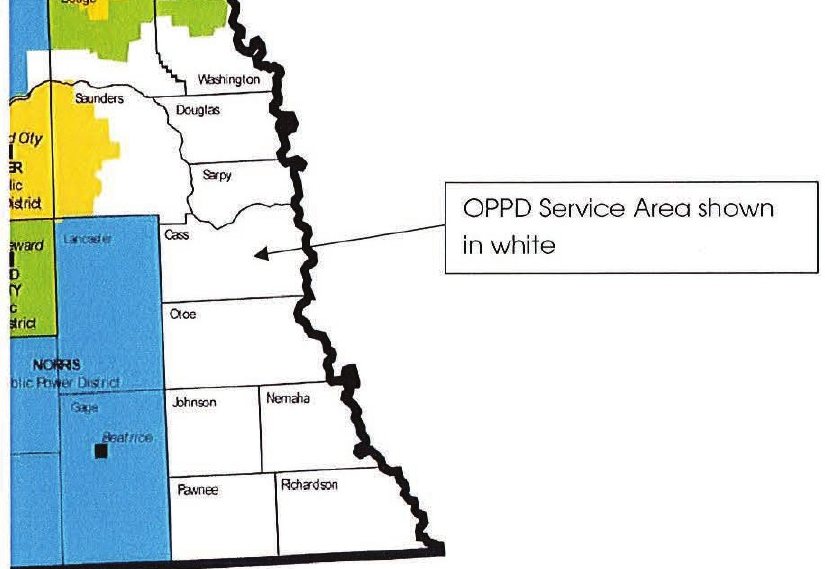
In June 2014, OPPD announced a plan to decrease the district’s dependence on non-renewable sources. After a survey of OPPD customers, the OPPD managers took the information and put together different options for meeting the desires of the consumers. There were initially three options “…and recommended one that will cut emission levels on various chemicals and gases by up to 85 percent. After studying the options, the board told management to proceed on that recommendation at its June 19, 2014 public meeting.”
“Following the plan, OPPD will shut down three of the five units at its North Omaha Station in 2016 and put stronger emissions controls on the other two units. Then, in 2023, OPPD will quit burning coal altogether in Omaha. Also in 2016, stronger emissions controls will be installed on Nebraska City Station’s older coal unit. It will also enact new energy-efficiency programs for customers and programs to reduce power usage. This reduction will cut OPPD’s need to generate power at key times by 300 megawatts, or 300 million watts.”
“It’s a comprehensive plan that, combined with additional wind energy already contracted for in the next few years, means the electricity OPPD customers use will continue to get cleaner and cleaner.”
Source: OPPD News Release
Electrical Distribution
The overall distribution system is in good condition. The system is owned and operated by OPPD as well. The distribution system not only supplies power throughout Douglas County but is the foundation for power that is transmitted to other customers in eastern Nebraska.
Natural Gas Service
Natural gas supplies in Douglas County are controlled by the Metropolitan Utilities District.
Metropolitan Utilities District (M.U.D.) is the only metropolitan utility district in the State of Nebraska. MUD is a public utility and is customer-owned. The District is governed by a board of seven directors, elected by its customer-owners.
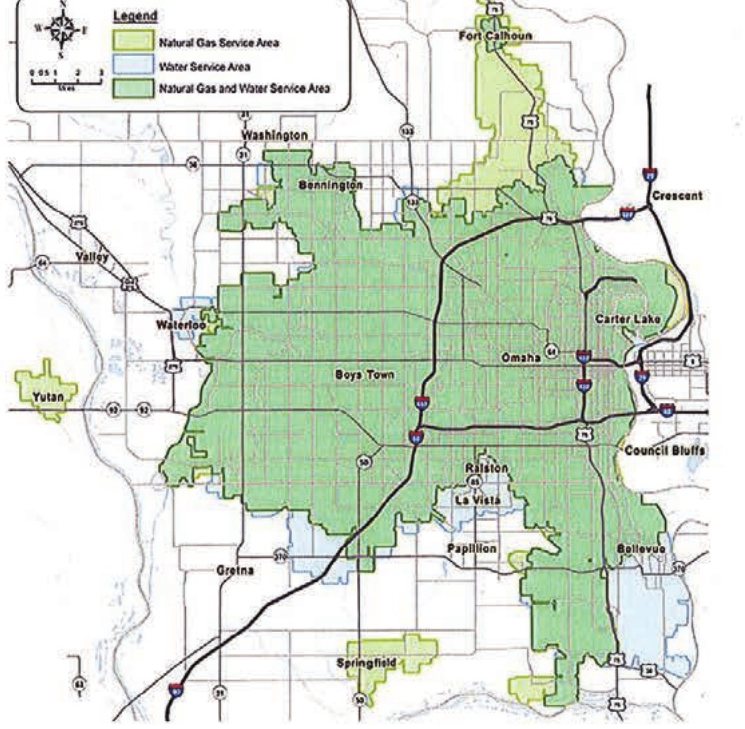
As the fifth largest public gas utility in the United States, MUD provides a product and service at rates that are lower than area investor-owned utilities and among the lowest in the Midwest. MUD serves natural gas to 221,023 customers in Omaha, Bennington, Fort Calhoun, Springfield, Yutan and 85 percent of Bellevue.
Source: http://www.mudomaha.com/about-us
Energy Use by Sector
This section analyzes the energy use by residential, commercial, industrial and other users and will examine the different types of energy sources that are utilized by these different sectors.
Residential Uses
Within Douglas County, residential uses are provided a number of options for both power and heating and cooling. These include electrical power (both fossil fuel and renewable resources), natural gas, oil, propane, and wood. The most dominant of the energy sources available and used by the residents of Douglas County is electricity produced from both fossil fuels and renewable resources.
The use of natural gas, oil, propane and wood will be found typically as heating sources during the winter months. The type of fuel used will depend a great deal on where a residence is located within the county. Residents located within the more urbanized parts of Douglas County are more likely to have natural gas heating or electrical furnaces. Propane and wood stoves are most likely found in the rural parts of the county where natural gas infrastructure is not available.
Commercial Uses
Douglas County’s commercial uses also have a number of options for both power and heating and cooling. These include electrical power (both fossil fuel and renewable resources), natural gas, propane, oil and wood. The type of energy source is very dependent upon the specific commercial use and the facilities employed to house the use. The most dominant of the energy sources available is electricity produced from both fossil fuels and renewable resources.
Similar to residential uses, the use of natural gas, oil, propane and wood will be found typically as heating sources during the winter months. The type of fuel used will depend a great deal on the type of commercial use and the construction of the building(s) involved. The location of the commercial uses will dictate, similar to residential uses, what type of heating fuels are used. However, in commercial uses such as repair garages and other uses in larger metal buildings, they may be dependent upon recycling used motor oils to heat their facilities.
Industrial Uses
Douglas County’s industrial uses will be very similar to those discussed within the commercial section. However, in some cases, diesel fuel can play a role in both power generation and heating and cooling.
Short-Term and Long-Term Strategies
As the need and even regulatory requirements for energy conservation increases, residents of Douglas County will need to:
- Become even more conservative with energy usage
- Make use of existing and future programs for retrofitting houses, businesses, and manufacturing plants
- Increase their dependence on renewable energy sources.
Residential Strategies
There are a number of different strategies that can be undertaken to improve energy efficiency and usage in residences. These strategies range from simple (less costly) to complex (costly). Unfortunately not all of the solutions will have an immediate return on investment. As individual property owners, residents will need to find strategies that fit their budgets to invest in the long-term savings.
There are several ways to make a residence more energy efficient. Some of the easiest include:
- Converting all incandescent light bulbs to Compact Florescent Lights (CFL) or Light Emitting Diodes (LED).
- Installing additional insulation in the attic.
- Converting standard thermostats to digital/programmable thermostats.
- Changing out older less efficient air conditioners and furnaces/boilers to newer high-efficiency units
- Changing out older appliances with new EnergyStar appliances.
- Exchanging less efficient water heaters with EnergyStar units or on demand systems.
Some of the more costly ways to make a residence more energy efficient include:
- New insulation in exterior walls.
- Addition of solar panels for either electrical conversion and/or water heater systems.
- Adding individual scale wind energy conversion systems.
- Installing a geothermal heating and cooling system.
- Installation of energy-efficient low-e windows.
Commercial / Industrial Strategies
Strategies for energy efficiency within commercial/industrial facilities are more difficult to achieve than those for residential uses. Typically, these improvements will require a greater amount of investment due to the size of most of these facilities.
There are a number of different strategies that can be undertaken to improve energy efficiency and usage in commercial and industrial facilities. Again, not all of the solutions will have an immediate return on investment. Businesses and industries will need to find strategies that will fit into their ability to pay for savings at the present time.
There are several ways to make businesses/industries more energy efficient. Some of the easiest include:
- Converting all incandescent light bulbs to more efficient Florescent Lights, or CFL’s or LED’s on small fixtures.
- Converting standard thermostats to digital/programmable thermostats.
- Installing additional insulation in an attic space.
- Changing out older less efficient air conditioners and furnaces/boilers to newer high-efficiency units.
- Exchanging less efficient water heaters with EnergyStar units or on demand systems.
Some of the more costly ways to make a business more energy efficient include:
- Installation of energy-efficient low-e windows and/or storefronts.
- New insulation in exterior walls.
- Addition of solar panels for either electrical conversion and/or water heater systems.
- Adding individual scale wind energy conversion systems.
- Installing a geothermal heating and cooling system.
- New storefronts with insulated panels and insulated Low-E glazing.
Public Strategies
Energy efficiency strategies for public facilities are similar to those of commercial and industrial users. Typically, these improvements will require a greater amount of investment due to the size of most of these facilities. However, in some cases there are grants available from time to time to assist public agencies with these improvements.
There are a number of different methods that can be undertaken to improve energy efficiency and usage in public facilities, including:
- Converting all incandescent light bulbs to more efficient Florescent Lights, or CFL’s or LED’s on small fixtures.
- Converting standard thermostats to digital/programmable thermostats.
- Installing additional insulation in an attic space.
- Changing out older less efficient air conditioners and furnaces/boilers to newer high-efficiency units.
- Exchanging less efficient water heaters with EnergyStar units or on demand systems.
Some of the more costly ways to make public facilities more energy efficient include:
- Installation of energy-efficient low-e windows and/or storefronts
- New insulation in exterior walls
- Addition of solar panels for either electrical conversion and/or water heater systems
- Adding individual scale wind energy conversion systems
- Installing a geothermal heating and cooling system
- New storefronts with insulated panels and insulated Low-E glazing
Renewable Energy Sources
Renewable energy sources, according to most definitions, include natural resources such as the wind, the sun, water, and the earth (geothermal) that can be used over and over again with minimal or no depletion, as well as tapping into sources of methane (from natural resources or man-made conditions). The most common sources of renewable energy used in Nebraska are the wind, the sun, water and earth. The following are examples of how these renewable resources can be used to reduce dependency on fossil fuels.
Wind
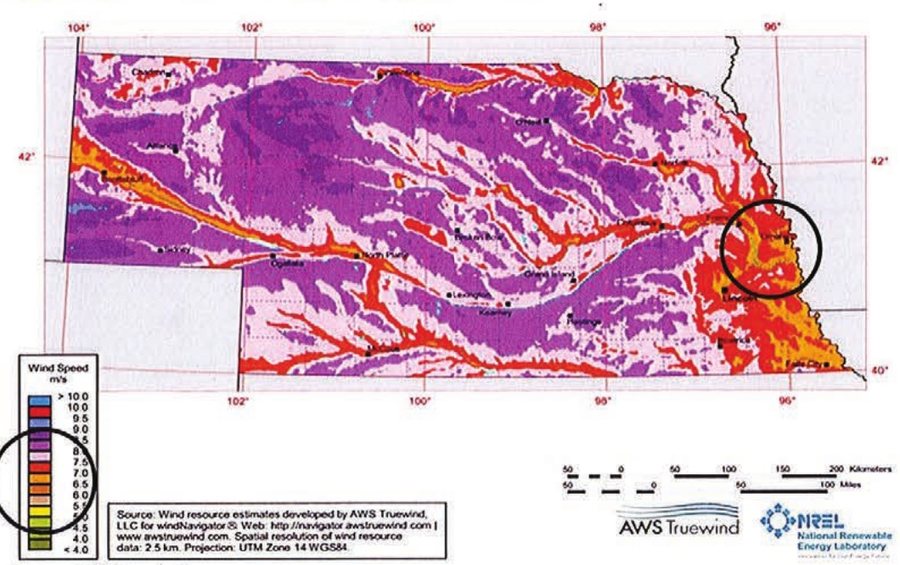
The wind is one of those resources in abundance in Nebraska. Wind is not a new technology in Nebraska; the pioneers that settled in Nebraska used wind mills for power and to work the water wells on their farms and ranches.
Wind can be used to produce electricity through the construction of small-scale or utility/commercial grade wind conversion systems (wind turbines). However, not all areas of the state have the ideal levels needed to produce electricity on a utility or commercial level; but the use of small-scale wind turbines on homes and businesses will work in most parts of Nebraska.
Solar
Solar energy has been around for decades and it last hit a high in popularity in the 1970’s. However, today’s solar energy design is much more efficient and aesthetically pleasing. Some of the aesthetic improvements have to do with the fact that today’s systems are not as bulky as their ancestors. Today, solar is being used much like wind turbines, on a small-scale level (home or business) or a much grander level (solar farms).
Solar energy includes solar water and space heating as well as taking solar photovoltaic panels to convert the sun’s rays into electricity. Solar panels can typically produce between 120 and 200 watts per square meter at an installed cost of $11 to $22 per watt, according to the American Solar Energy Society, but these costs are becoming less every year as more solar units are commissioned and new more cost effective technologies are developed.
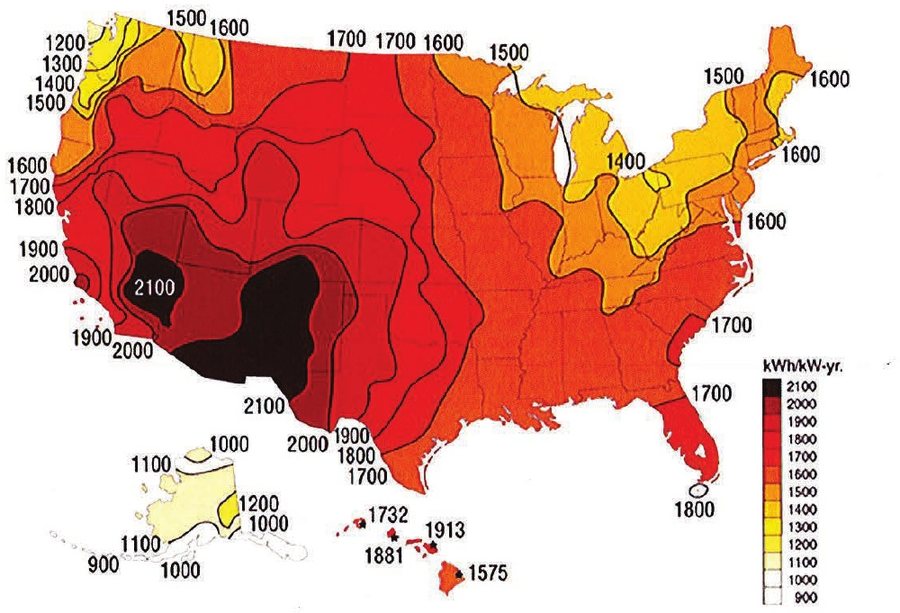
Based upon the diagram below there is great solar potential in the state of Nebraska. A majority of the state lies within some of the better areas in the country for solar potential.
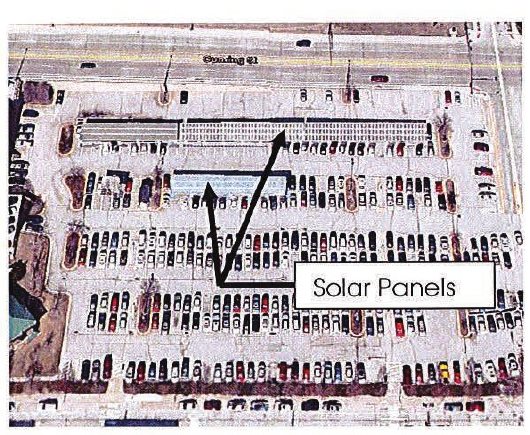
In addition, special urbanized solar farms can be constructed as a dual purpose for generating shade and electricity, as seen below (the parking lot is located at 25th and Cuming Streets in downtown Omaha).
In the future, it may become desirable for new subdivisions/developments to incorporate renewable energy systems such as solar and wind. In order for this to occur, a standard subdivision regulation and zoning code would likely need to be modified in order to allow these systems. In addition, the state regulations under the C-Bed program would likely need to be updated.
Geothermal Energy
Geothermal energy is typically utilized through a process where a series of pipes are lowered into vertical cores called heat-sink wells. The pipes carry a highly conductive fluid that either is heated or cooled by the constant temperature of the ground. The resulting heat exchange is then transferred back into the heating and cooling system of a home or other structure. This is called a geothermal heat exchange system or ground source heat pump. The California Energy Commission estimates the costs of a geothermal system can earn net savings immediately when financed as part of a 30-year mortgage (Source: American Planning Association, PAS Memo January/February 2009).
Methane Energy
The use of methane to generate electricity is becoming more cost-effective to use in Nebraska. Methane electrical generation can be accomplished through the use of a methane digester which takes the raw gas, naturally generated from some form of decomposing material, and converts the gas into electrical power.
There have been some attempts to take the methane generated from animal manure and convert it into electricity; most have been successful but were costly to develop. Another approach to methane electrical generation is to tap into the methane being generated from a solid waste landfill; instead of burning off the methane, it can be piped into a methane convertor and generated into electricity for operating a manufacturing plant or placed on the overall grid for distribution.
Methane convertors make use of unwanted gases and are able to produce a viable product. As long as humans need to throw garbage into a landfill or the production of livestock is required, there will be a source of methane to tap for electrical generation.
Douglas County Landfills and Methane
Pheasant Point facility (Active landfill)
Currently, OPPD operates a methane gas power plant at the Douglas County landfill near Elk City. The methane gas produced by the landfill powers four 800 kW internal combustion engine generators. The initial output of the Elk City plant was anticipated to be 3.2 MW with growth expected to top out at 10 times that level. In addition to converting methane into electricity, it can also provide a source of power by replacing natural gas as a heating source.
State Street facility (Closed landfill)
Douglas County has engaged BioResource Development, LLC, a landfill gas and advanced biofuel developer, to develop a beneficial use project for the landfill gas generated and subsequently combusted at the State Street Landfill. The developer has performed an engineering study to determine the feasibility of diverting the landfill gas that was formally destroyed in a flare, to a facility that will process the raw landfill gas into a high-BTU, pipeline-quality gas to be placed on the natural gas pipeline system for use. In return for the rights to the landfill gas, the developer will assume the operations and maintenance of the County’s gas collection and flare system, providing a direct annual budget savings to the County. The project will be funded entirely with private monies requiring no financial participation by the County or obligation of County resources or financial security. The project creates a beneficial use for the methane produced naturally by the landfill, overall greenhouse gas emissions at the landfill will be further reduced due to improvements in the collection system and operations, and the County will realize an annual cost savings in its operating budget.
State Programs
The following provides a basic history and description of some newer programs in Nebraska; interested parties should contact the State of Nebraska Energy Office or OPPD/MUD.
C-BED Program
In May 2007, Nebraska established an exemption from the sales and use tax imposed on the gross receipts from the sale, lease, or rental of personal property for use in a community-based energy development (C-BED) project. The Tax Commissioner is required to establish filing requirements to claim the exemption. In April 2008 L.B. 916 made several amendments to this incentive, including: (1) clarified C-BED ownership criteria to recognize ownership by partnerships, cooperatives and other pass-through entities; (2) clarified that the restriction on power purchase agreement payments should be calculated according to gross and not net receipts; (3) added language detailing the review authority of the Tax Commissioner and recovery of exempted taxes; and (4) defined local payments to include lease payments, easement payments, and real and personal property tax receipts from a C-BED project.
A C-BED project is defined as a new wind energy project that meets one of the following ownership conditions:
- For a C-BED project that consists of more than two turbines, the project is owned by qualified owners with no single qualified owner owning more than 15% of the project and with at least 33% of the power purchase agreement payments flowing to the qualified owner or owners or local community; or
- For a C-BED project that consists of one or two turbines, the project is owned by one or more qualified owners with at least 33% of the power purchase agreement payments flowing to a qualified owner or local community.
In addition, a resolution of support for the project must be adopted by the county board of each county in which the C-BED project is to be located.
A qualified C-BED project owner means:
- a Nebraska resident;
- a limited liability company that is organized under the Limited Liability Company Act and that is entirely made up of members who are Nebraska residents;
- a Nebraska nonprofit corporation;
- An electric supplier(s), subject to certain limitations for a single C-BED project.
In separate legislation (LB 629), also enacted in May 2007, Nebraska established the Rural Community-Based Energy Development Act to authorize and encourage electric utilities to enter into power purchase agreements with C-BED project developers.
Local Government and Renewable Energy Policies
Local governments can take steps to encourage greater participation in wind generation. Cities and counties can pursue strategies to make these projects more attractive, including:
- Develop or amend existing zoning regulations to allow small-scale wind turbines as an accessory use in all districts.
- Develop or amend existing zoning regulations to exempt small-scale turbines from maximum height requirements when attached to an existing or new structure; provided, they meet all building codes and manufacturers requirements for attachment.
- Work with the OPPD on ways to use wind turbines on small-scale individual projects or as a source of power for the community.
Net Metering in Nebraska
LB 436, signed in May 2009, established statewide net metering rules for all electric utilities in Nebraska. The rules apply to electricity generating facilities which use solar, methane, wind, biomass, hydropower or geothermal energy, and have a rated capacity at or below 25 kilowatts (kW). Electricity produced by a qualified renewable energy system during a month shall be used to offset any kilowatt-hours (kWh) consumed at the premises during the month.
Any excess generation produced by the system during the month will be credited at the utility’s avoided cost rate for that month and carried forward to the next billing period. Any excess remaining at the end of an annualized period will be paid out to the customer. Customers retain all renewable energy credits (RECs) associated with the electricity their system generates. Utilities are required to offer net metering until the aggregate generating capacity of all customer-generators equals one percent of the utility’s average monthly peak demand for that year.
State Law of Solar and Wind Easements
Nebraska’s solar and wind easement provisions allow property owners to create binding solar and wind easements for the purpose of protecting and maintaining proper access to sunlight and wind. Originally designed only to apply to solar, the laws were revised in March 1997 (LB 140) to include wind. Counties and municipalities are permitted to develop regulations, or development plans protecting access to solar and wind energy resources if they choose to do so. Local governing bodies may also grant zoning variances to solar and wind energy systems that would be restricted under existing regulations, so long as the variance is not substantially detrimental to the public good.
LB 568, enacted in May 2009, made some revisions to the law and added additional provisions to govern the establishment and termination of wind agreements. Specifically, the bill provides that the initial term of a wind agreement may not exceed forty years. Additionally, a wind agreement will terminate if development has not commenced within ten years of the effective date of the wind agreement. If all parties involved agree to extend this period, however, the agreement may be extended.
Current Renewable Energy Programs / Funding Sources
There are several programs available through OPPD to assist in purchasing and installing more energy efficient equipment in residences and businesses. In addition, there are funding opportunities through the Nebraska Energy Office.